Acetylsalicylic acid API
50-78-2
Commercial
What is Acetylsalicylic acid?
Acetylsalicylic acid is one of the most well-known and important medicines (listed as indispensable by the WHO since 1977). It has an analgesic, anti-inflammatory, antipyretic and platelet-inhibiting effect. It is a nonsteroidal anti-inflammatory drug (NSAID).
Chemical properties drub substance Acetylsalicylic acid
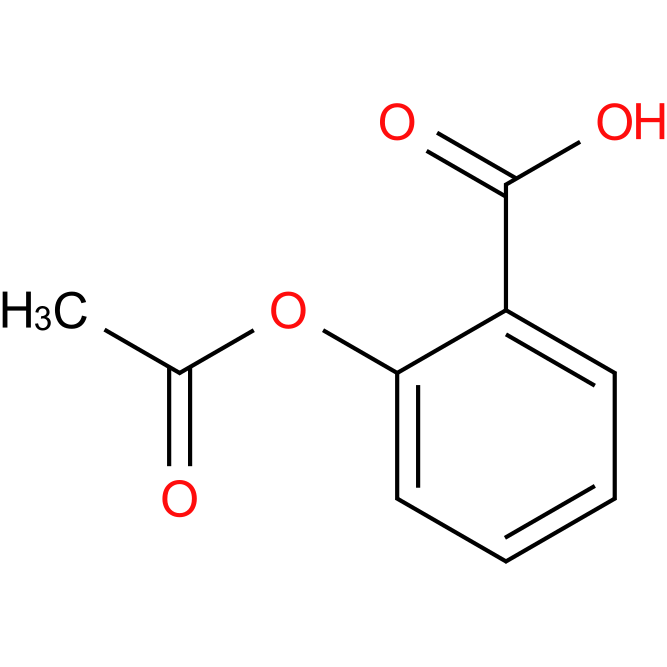
Formula
Molecular weight
Molecular size
Controlled Substance
Precursor
Indications
-
Learn more about the API Acetylsalicylic acid
Acetylsalicylic acid (CAS number: 50‑78‑2), also known by the abbreviation ASA, is an NSAID (non‑steroidal anti‑inflammatory drug) used as an analgesic, antipyretic, and inhibitor of platelet aggregation.
Chemical properties of acetylsalicylic acid
Acetylsalicylic acid is produced through esterification of salicylic acid and, as a salicylate derivative, is one of the well‑established pharmaceutical APIs (Active Pharmaceutical Ingredients).
Its molecular formula is C₉H₈O₄, and its molar mass is 180.2 g/mol.
Acetylsalicylic acid is only sparingly soluble in water, but soluble in chloroform and ether, and slightly soluble in ethanol. The API occurs as a white crystalline powder or as colorless crystals. It is almost odorless and has a distinctly acidic taste.Mechanism of action of acetylsalicylic acid
The action of acetylsalicylic acid is based on inhibition of cyclooxygenase, resulting in inactivation of both COX‑1 and COX‑2. Because this blocks protective mechanisms of the gastric mucosa and the substance also has a direct irritant effect, gastric ulcers may rarely occur as an adverse reaction.
At low doses, ASA causes irreversible COX‑1 inhibition and thus suppresses thromboxane A₂ formation in platelets. This reduces platelet aggregation and lowers the risk of arterial thrombosis. This mechanism is used for cardiovascular prophylaxis and for secondary prevention of myocardial infarction.
At higher doses, ASA increasingly inhibits COX‑2 as well. This leads to suppression of prostaglandin synthesis, reducing the formation of prostaglandins, which play an important role in pain, inflammation, and fever. Additionally, acetylsalicylic acid stimulates COX‑2 to produce anti‑inflammatory lipoxins.
Quality attributes of acetylsalicylic acid
For pharmaceutical applications, acetylsalicylic acid is characterized by defined quality attributes, including controlled particle size, stable polymorphic form, and compliance with ICH Q3C limits for residual solvents. [1]
The API is also subjected to nitrosamine risk assessment in accordance with current regulatory requirements. [2]
Supply of acetylsalicylic acid is ensured through qualified, GMP‑compliant supply chains with scalable production capacities, supporting high supply reliability and long‑term availability.Sources:
[1] https://www.ema.europa.eu/en/ich-q3c-r9-residual-solvents-scientific-guideline
Your Contact
Marius Hang
International Division
Director API Export
Rheinstr. 49
55218 Ingelheim
Germany
-
Disclaimer
The information contained herein is the proprietary information of Midas Pharma GmbH and its affiliates. This information is provided to you solely for your evaluation, to determine your interest in a potential business relationship with Midas Pharma GmbH and/or its affiliates. Midas Pharma GmbH excludes any express or implied representations, guarantees or warranties of whatsoever nature, including but not limited to the warranties for the completeness or accuracy of the information provided herein.
No information provided herein – including any reference to any product or service – constitutes an offer for sale, or shall be construed as representing an offer for sale. In particular, nothing herein should be construed as a promotion or advertisement for any product, or for the use of any product, that infringes valid patents and/or is not authorized by the laws and regulations of your country of residence.